Economic Geography

Winter intake start date
2027-02-01
Winter intake deadline
2026-10-15
Global Transformations, Local Impacts
The world is changing at a rapid pace and the consequences affect regions and people unevenly. Technological changes, such as digitalization and automation, affect the way jobs are organized and how the economy is structured. Climate change increases the risk of food shortages, water scarcity, and the occurrence of natural disasters. These, in turn, affect people's wellbeing and businesses' production decisions and possibilities. In many places, demographic changes, such as ageing and migration, challenge the provision of services and call for a new organization of the society. The effects of these global megatrends are not symmetric, some people benefit some do not, some place benefits some do not.
Economic Geography in Groningen is about understanding these inequalities across space and people: regional differences in economic structure and performance as well as in socio-economic outcomes in a broad sense. Our starting point in understanding these inequalities between places and people are the actions of three main economic actors: Firms, People, and the Government. Understanding their behaviour (e.g., migration, firm location, policies) is an important pillar of the programme.
The master in Economic Geography develops your academic research and professional skills so that you can analyze such regional developments and formulate policy avenues to govern these processes locally, nationally, and internationally. This makes Economic Geography in Groningen an empirical and pragmatic programme that is relevant for society.
Our graduates are specialists in regional economic development with a keen eye on the role of policy. For those interested in the role of international trade and globalization in regional economic development we offer a track in Regional Competitiveness and Trade, where you will specialize in a quantitative and model based economic approach. We also offer a track in Resilient Rural Regions, where you will explore the rural-specific socio-spatial impacts of global transformations and how rural regions and communities deal with such transformations in socially and environmentally sustainable and place-specific ways.
If you are interested in following a two-year programme in Economic Geography in two different countries (the Netherlands and Germany) where you get two master's degrees, then our Dual Degree Master International Programme in Economic Geography is the master programme for you!
If you are looking for a two-year programme and are interested in doing research, you can also integrate the master in Economic Geography with our two-year Research Master in Spatial Sciences.
Na studia magisterskie mogą kandydować wszyscy, którzy ukończyli studia licencjackie lub inżynierskie (studia I stopnia), studia magisterskie lub studiują na ostatnim roku studiów I-stopnia. Studia, które planujesz powinny mieć zbliżony profil do tych obecnych lub ukończonych, ponieważ w procesie rekrutacji kluczowa jest ich zgodność programowa.
- Wykaz punktów ECTS – osoby, które są jeszcze w trakcie studiów, muszą załączyć wypis punktów ECTS, w którym będzie wykazane, jakie przedmioty były realizowane na studiach oraz ile punktów za nie otrzymano.
- Dyplom ukończenia studiów licencjackich lub inżynierskich – jeśli jesteś absolwentem wyższej uczelni, nie potrzebujesz wypisu, wystarczy załączyć dyplom ukończenia studiów wraz z suplementem (w języku angielskim lub oryginał z tłumaczeniem)
- Uwaga! Każdy kierunek magisterski może mieć inne wymagania i wymagać specyficznych dodatkowych dokumentów. Przed aplikacją sprawdź na stronie uczelni, jakich dokumentów potrzebujesz!
WAŻNE! Opłata rekrutacyjna – uniwersytet pobiera opłatę rekrutacyjną w wysokości 100 EUR, którą należy uiścić przy składaniu aplikacji (po wysłaniu formularza Kastu zostaniesz poinformowany o sposobie jej uiszczenia). TUTAJ znajdziesz więcej informacji na temat tej opłaty.
Applicants have to prove their English language skills either by an internationally recognized language test or upon previous studies. Usually English language skills can be proved by the following documents:
- TOEFL iBT*
- IELTS Academic
- A Cambridge English qualification
- Higher education degree completed in English
- Secondary education completed in English in a country or school qualification accepted by the university
- An English subject and grade on your secondary school leaving certificate that meet the university’s requirements
- Other
Important: Accepted methods and minimum results depend on study programme and the country where you completed your education. Check the official requirements for your chosen study programme.
*Use the Kastu promo code LTU1000102 when registering for TOEFL iBT and receive a 5% discount.
Bachelor degree related to the field of regional economic development. This includes Bachelor programmes in Human Geography, Economic Geography, Regional and Urban Planning, Regional Economy, Economics & Business Economics, Economy or related. Bachelordiploma's in Sociology, Business Administration, Small Business and Entrepreneurship, Micro-Economics are sometimes admissible.
10 ECTS in Statistics required
Job prospects
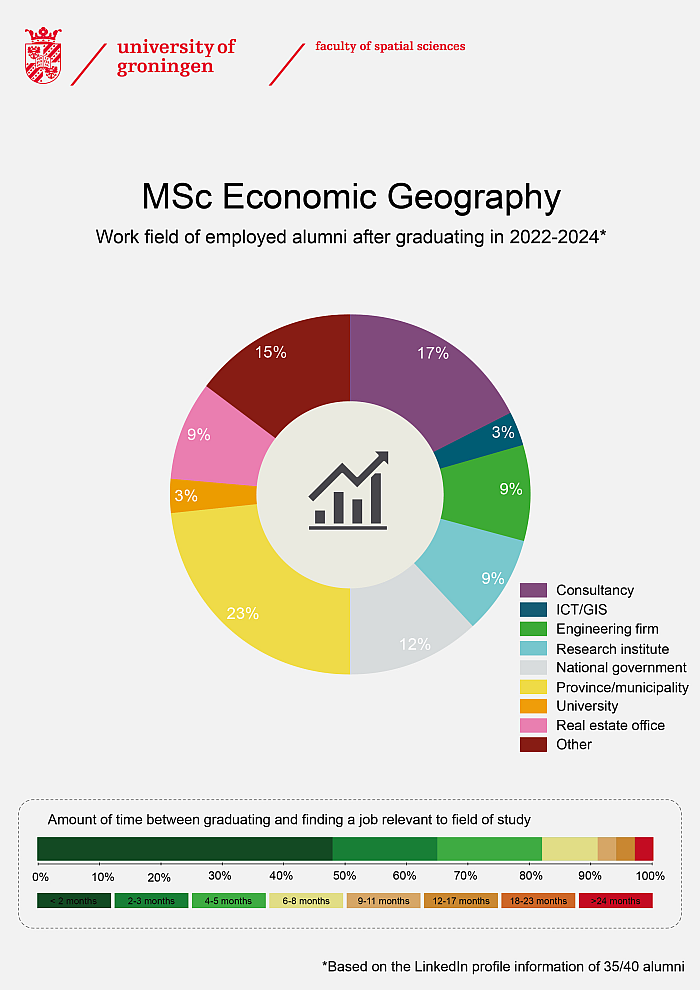
- A fair share of the graduates is employed by governmental organizations at all geographical levels (cities and municipalities, regional, national and international governmental organizations). This includes organizations such as the EU, the city of Amsterdam or The Dutch Ministry of Environment and Infrastructure.
- Another large share of the graduates is active on the commercial market, mostly in consultancies in economic development. This includes companies such as Twijnstra Gudde, Antea.
- A smaller share of the graduates enters research, teaching and entrepreneurship.
To see where our Economic Geography alumni end up, view this infographic
Throughout the year we offer support for practical career preparation and employability skills. Workshops are given about leadership, job interviews and how to present yourself. More information about the FSS Career Services.
Nie znalazłeś odpowiedzi?